The development and testing of a novel vibration-based medical insole device that improves balance.
Background
Ultimate Frisbee [^1] is a relatively new sport, but one that is rapidly growing in popularity worldwide. (If you’re unfamiliar with the sport, watch a quick explanation or some exciting highlights of the most recent World Championships here!) As a newcomer on the scene, traditional team coaching has been mainly based on the “eye test”, requiring highly experienced coaches/players to identify strengths to be honed and weaknesses to be rectified.
However, a few potential issues can arise from this. Firstly, as Ultimate is a highly dynamic game, it can be difficult for a single coach to identify all the potential moments of interest at once. While this could be remedied by simply having more coaches, due to Ultimate’s relative newness, this is not always possible for many non-pro teams. Secondly, even experienced coaches are only human - as much as we try to avoid it, unconscious bias can creep into the system. As such, having a data-driven, objective reference point can serve as a grounding point for coaches, assisting them and allowing them to do more with less.
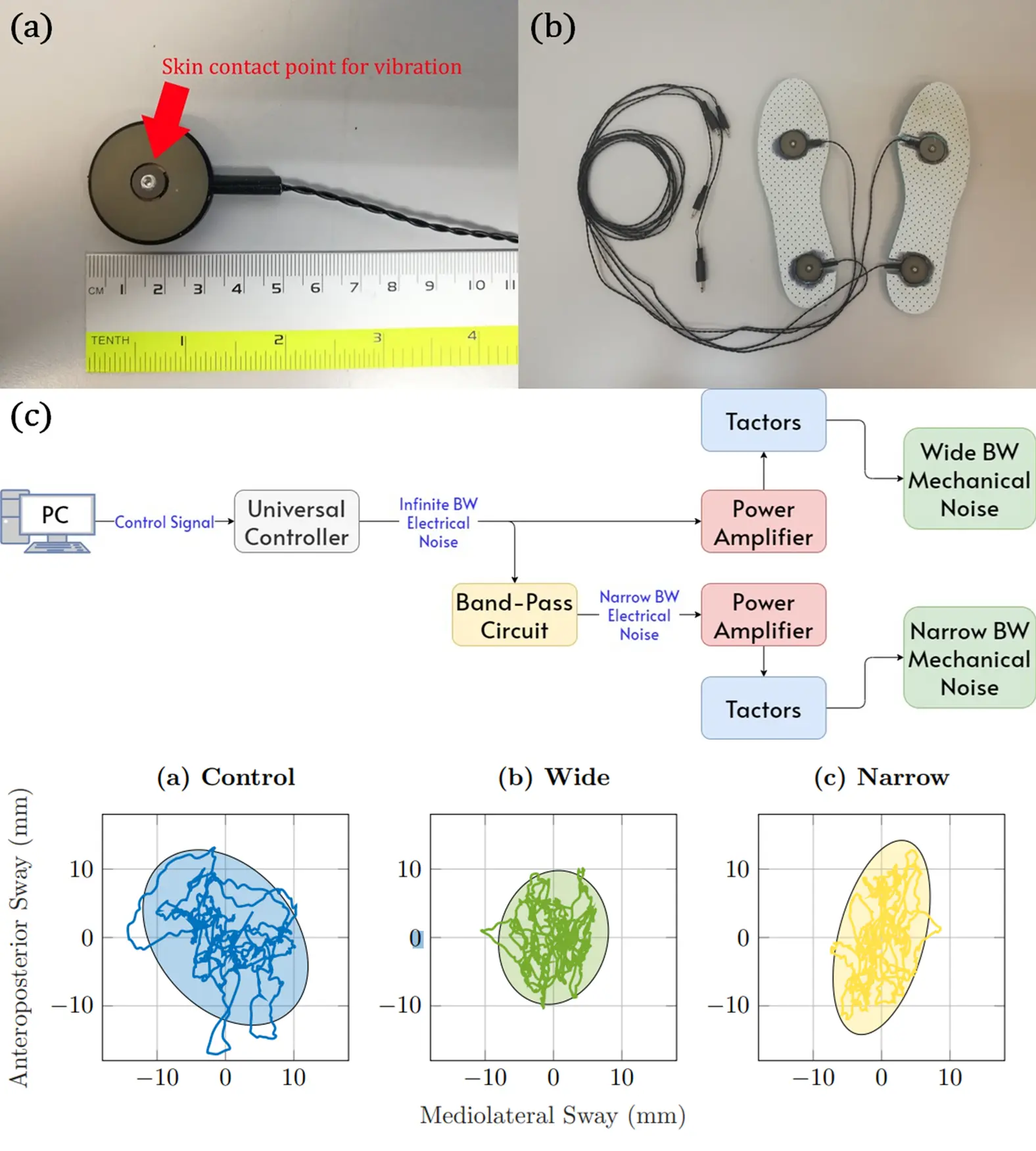
Although the application of sub-sensory mechanical noise to the soles of the feet has been shown to enhance balance, there has been no study on how the bandwidth of the noise affects balance. Here, we report a single-blind randomized controlled study on the effects of a narrow and wide bandwidth mechanical noise on healthy young subjects’ sway during quiet standing on firm and compliant surfaces. For the firm surface, there was no improvement in balance for both bandwidths—this may be because the young subjects could already balance near-optimally or optimally on the surface by themselves. For the compliant surface, balance improved with the introduction of wide but not narrow bandwidth noise, and balance is improved for wide compared to narrow bandwidth noise. This could be explained using a simple model, which suggests that adding noise to a sub-threshold pressure stimulus results in markedly different frequency of nerve impulse transmitted to the brain for the narrow and wide bandwidth noise—the frequency is negligible for the former but significantly higher for the latter. Our results suggest that if a person’s standing balance is not optimal (for example, due to aging), it could be improved by applying a wide bandwidth noise to the feet.
@article{khor2021,title={The Effects of Mechanical Noise Bandwidth on Balance across Flat and Compliant Surfaces},author={Khor, Jeshaiah Zhen Syuen and Gopalai, Alpha Agape and Lan, Boon Leong and Gouwanda, Darwin and Ahmad, Siti Anom},year={2021},month=jun,journal={Scientific Reports},volume={11},number={1},pages={12276},publisher={Nature Publishing Group},issn={2045-2322},doi={10.1038/s41598-021-91422-w},urldate={2021-07-26},copyright={2021 The Author(s)},langid={english},bibtex_show=true,selected=true,}