publications
publications by categories in reversed chronological order. generated by jekyll-scholar.
2022
- Conf. Proc.
 Mechanical Noise Affects Rambling and Trembling Trajectories During Quiet StandingJeshaiah Z.S. Khor, Alpha A. Gopalai, Boon L. Lan, and 2 more authorsIn 2022 IEEE-EMBS Conference on Biomedical Engineering and Sciences (IECBES), Dec 2022
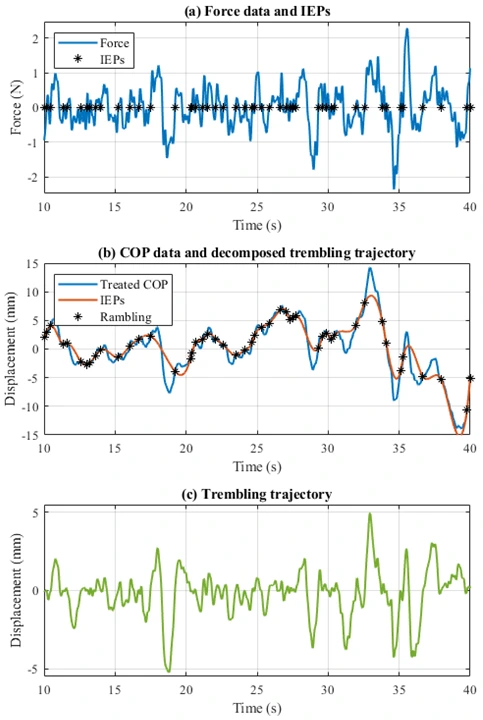
Falling is a serious worldwide public health issue, leading to heavy interest in the development of interventions to reduce fall risk. Mechanical noise has been shown to be a promising candidate in this regard - the application of mechanical noise to the foot sole has been shown to improve the sensitivity of the foot sole to pressure stimuli, thereby improving postural control and reducing fall risk. However, the mechanism by which mechanical noise affects the neural drive responsible for postural control is yet unknown. A single-blind randomized controlled study was conducted on the bodily sway of 19 healthy young subjects during quiet standing balance on a firm and compliant surface with and without introduced mechanical noise. The trajectory of the center of pressure (COP) of the subjects during balance was decomposed into its constituent rambling and trembling components, which reflected supraspinal and reflexive neural control respectively. On the compliant surface, the introduction of mechanical noise significantly reduced sway compared to control in the overall COP trajectory as well as the rambling and trembling trajectories. These findings indicate that mechanical noise can improve neural control of balance through both the supraspinal and reflexive neural pathways, leading to tighter bodily control and reduced bodily sway. These findings are particularly promising for the development of targeted noise-based assistive devices to reduce fall risk in demographics with neurological issues impairing motor control and balance.Clinical Relevance– This study demonstrates that mechanical vibratory noise introduced to the foot sole reduces both rambling and trembling of the COP during postural control, thus improving balance, with a wider bandwidth of mechanical noise having a larger effect. This has practical applications in the development of noise-based wearable devices for fall risk reduction.
@inproceedings{khor2022, title = {Mechanical {{Noise Affects Rambling}} and {{Trembling Trajectories During Quiet Standing}}}, booktitle = {2022 {{IEEE-EMBS Conference}} on {{Biomedical Engineering}} and {{Sciences}} ({{IECBES}})}, author = {Khor, Jeshaiah Z.S. and Gopalai, Alpha A. and Lan, Boon L. and Ahmad, Siti A. and Gouwanda, Darwin}, year = {2022}, month = dec, pages = {252--257}, doi = {10.1109/IECBES54088.2022.10079555}, urldate = {2023-12-15}, bibtex_show = true, selected = true } - PhD Thesis
 Quantifying the Effects of Mechanical Noise Bandwidth on Postural Control in a Noise-Based InsoleJeshaiah Zhen Syuen KhorNov 2022
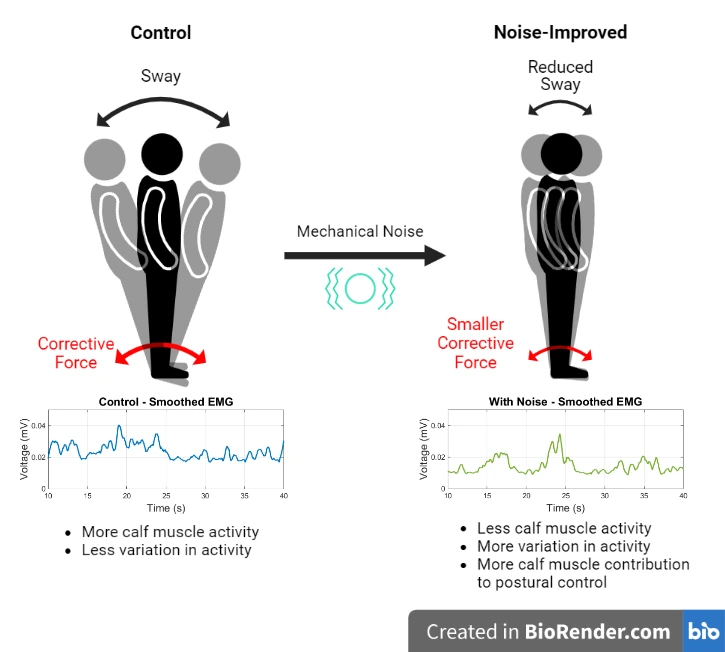
This thesis investigated the effects of different types of mechanical vibration introduced to the foot sole on balance and the biological systems involved in maintaining it. Mechanical vibration improves the sensitivity of the foot sole to pressure changes during balance, giving the brain more information on the body’s posture. The brain can then use the calf muscles to control balance more effectively, resulting in improved balance. This beneficial effect on balance is more prominent when the mechanical vibration contains the broadest possible range of frequencies.
@phdthesis{khor2022a,
  type = {Thesis},
  title = {Quantifying the {{Effects}} of {{Mechanical Noise Bandwidth}} on {{Postural Control}} in a {{Noise-Based Insole}}},
  author = {Khor, Jeshaiah Zhen Syuen},
  year = {2022},
  month = nov,
  doi = {10.26180/21500493.v1},
  urldate = {2024-11-24},
  langid = {english},
  school = {Monash University},
  file = {C:\Users\jesha\Zotero\storage\JV4KQXPL\Khor - 2022 - Quantifying the Effects of Mechanical Noise Bandwi.pdf},
  bibtex_show = true,
  selected = false,
}
2021
- Journal
 The Effects of Mechanical Noise Bandwidth on Balance across Flat and Compliant SurfacesJeshaiah Zhen Syuen Khor, Alpha Agape Gopalai, Boon Leong Lan, and 2 more authorsScientific Reports, Jun 2021
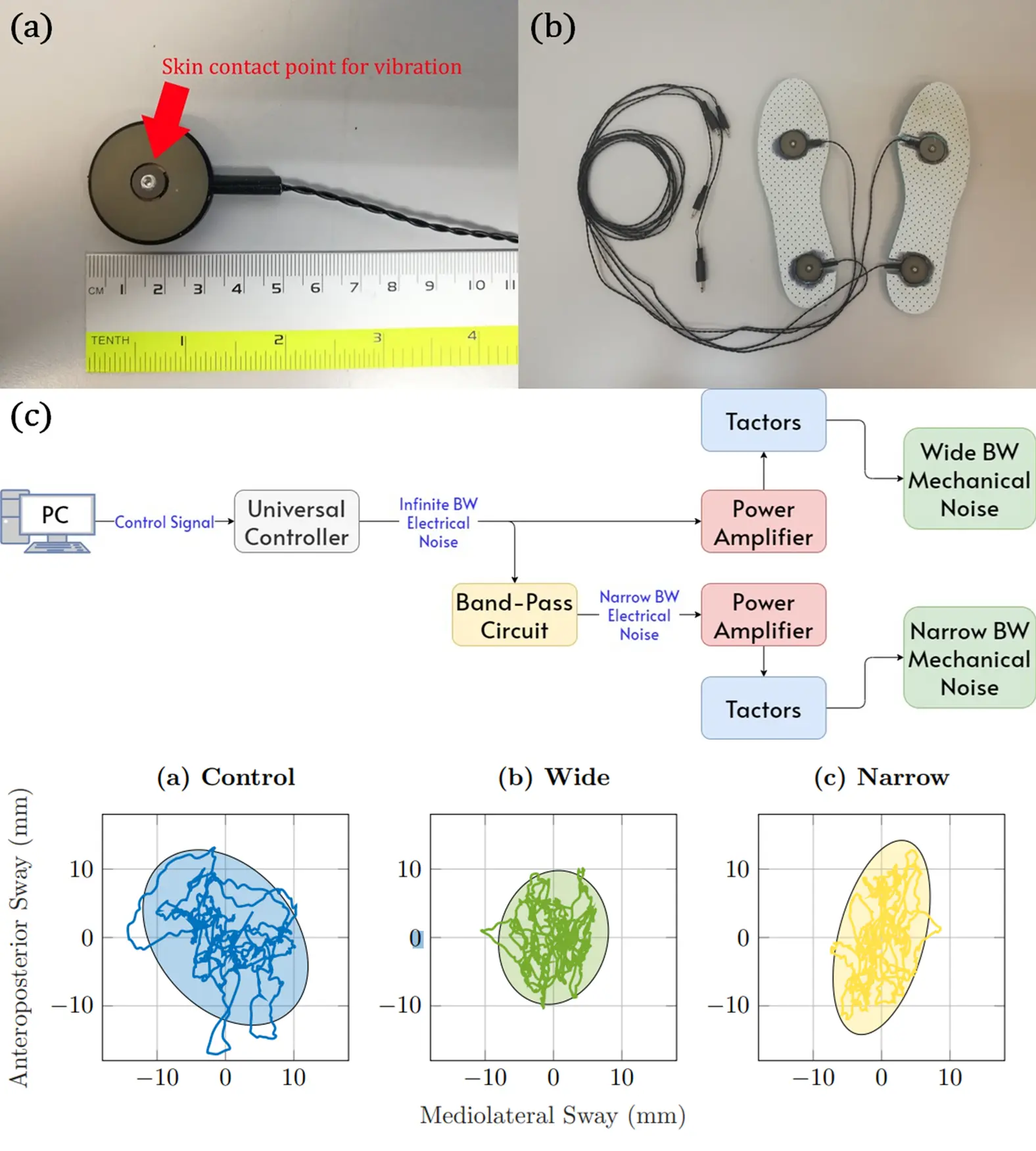
Although the application of sub-sensory mechanical noise to the soles of the feet has been shown to enhance balance, there has been no study on how the bandwidth of the noise affects balance. Here, we report a single-blind randomized controlled study on the effects of a narrow and wide bandwidth mechanical noise on healthy young subjects’ sway during quiet standing on firm and compliant surfaces. For the firm surface, there was no improvement in balance for both bandwidths—this may be because the young subjects could already balance near-optimally or optimally on the surface by themselves. For the compliant surface, balance improved with the introduction of wide but not narrow bandwidth noise, and balance is improved for wide compared to narrow bandwidth noise. This could be explained using a simple model, which suggests that adding noise to a sub-threshold pressure stimulus results in markedly different frequency of nerve impulse transmitted to the brain for the narrow and wide bandwidth noise—the frequency is negligible for the former but significantly higher for the latter. Our results suggest that if a person’s standing balance is not optimal (for example, due to aging), it could be improved by applying a wide bandwidth noise to the feet.
@article{khor2021,
  title = {The Effects of Mechanical Noise Bandwidth on Balance across Flat and Compliant Surfaces},
  author = {Khor, Jeshaiah Zhen Syuen and Gopalai, Alpha Agape and Lan, Boon Leong and Gouwanda, Darwin and Ahmad, Siti Anom},
  year = {2021},
  month = jun,
  journal = {Scientific Reports},
  volume = {11},
  number = {1},
  pages = {12276},
  publisher = {Nature Publishing Group},
  issn = {2045-2322},
  doi = {10.1038/s41598-021-91422-w},
  urldate = {2021-07-26},
  copyright = {2021 The Author(s)},
  langid = {english},
  bibtex_show = true,
  selected = true,
}